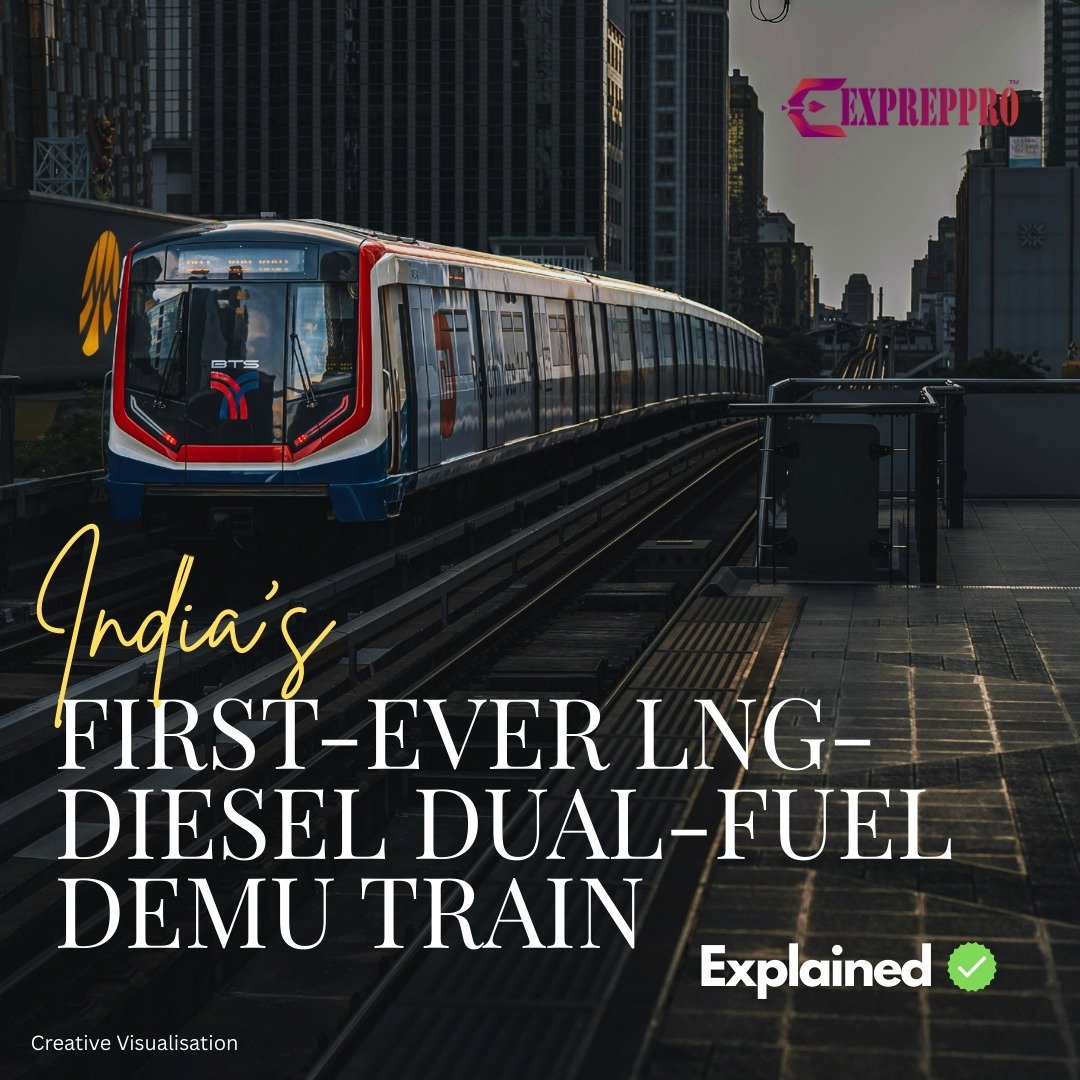
Indian Railway successfully converted a DEMU train (diesel-electric multiple unit) to India’s first dual-fuel DEMU train (LNG and Diesel) at Integrated Coach Depot, Sabarmati. Diesel-electric multiple units are rail vehicles that combine diesel engines with electrical traction systems. With this successful change, the railways achieved a significant milestone in clean, cost-effective operations.
What is DEMU or Diesel Electric Multiple Unit ?
A diesel multiple unit is a type of self-propelled railway vehicle utilised primarily in urban, suburban, and inter-regional service areas that are not electrified or partially electrified. The DMU also has similar equipment to diesel locomotives, but instead of pantographs and electrical control circuits of high-voltage equipment, it has diesel power plants that produce energy and transfer it by traction transmission. DMU can be divided into three categories:
- Diesel Electric Multiple Units (DEMU)
- Diesel Mechanical Multiple Units
- Diesel Hydraulic Multiple Units
What are the key features of DEMU?
- It is self-propelled with the help of a diesel engine that generates electricity, which powers the electric traction motors. Each unit can operate independently without the need for a separate locomotive.
- It can include both motorised and non-motorised configurations. The motorised cars are equipped with power units. The non-motorised cars can increase passenger capacity without additional propulsion systems.
- The electric transmission used in DEMU is more efficient than others, enabling good performance and smooth acceleration.
Advantages of DEMU.
- DEMUs are more fuel-efficient than conventional diesel mechanical systems. It also produces high performance while minimising fuel consumption and reducing operating costs over time.
- It significantly reduces the infrastructure investments needed to maintain rail services in non-electrified routes.
- It can be started and put into operation more quickly than conventional diesel locomotives. So they can be deployed very quickly.
What are its limitations?
- Requires regular and intensive maintenance.
- It relies on diesel fuel, which poses a challenge to carbon-emissions reduction plans.
Why this LNG-powered DEMU?
By converting a 1,400-horsepower DEMU to first dual-fuel DEMU train using LNG, it will reduce around 40% of traditional diesel fuel consumption. Each railcar is fitted with a 2200-litre LNG tank that helps the DEMU to travel up to 222 km per day, and it has already completed over 2000 km of field trials. The RDSO emission test after trials gave a positive result, and the railway is now planning to convert 8 more DEMUs to dual-fuel LNG-diesel mode.
Advantages of LNG.
Liquefied Natural Gas (LNG) is the liquid form of natural gas, primarily consisting of methane (CH₄), which has been cooled to approximately -162°C. This cooling reduces its volume by about 600 times compared to its gaseous state, which helps in storage and transport. LNG is colourless, odourless, non-toxic, non-corrosive, lighter than water, has a high amount of energy relative to its volume and does not pose a threat even in the case of a leak, because it evaporates quickly at ambient temperatures.
Dual-Fuel CNG-Diesel DEMU.
India’s first ‘Eco-Friendly’ dual-fuel GNG-Diesel Electric Multiple Unit (DEMU) was already launched by ICF, or Integral Coach Factory. The CNG-based dual-fuel 1400 HP engine used in DEMU trains developed by IROAF has successfully substituted diesel fuel with CNG up to 20%. This innovation will reduce emissions considerably by lowering NOx by 16%, CO2 by 6%, and Particulate Matter by 18%, while achieving a 8% reduction in fuel costs. For this innovation, IROAF received the 2017 Golden Peacock Awards, instituted by the Institute of Directors.