
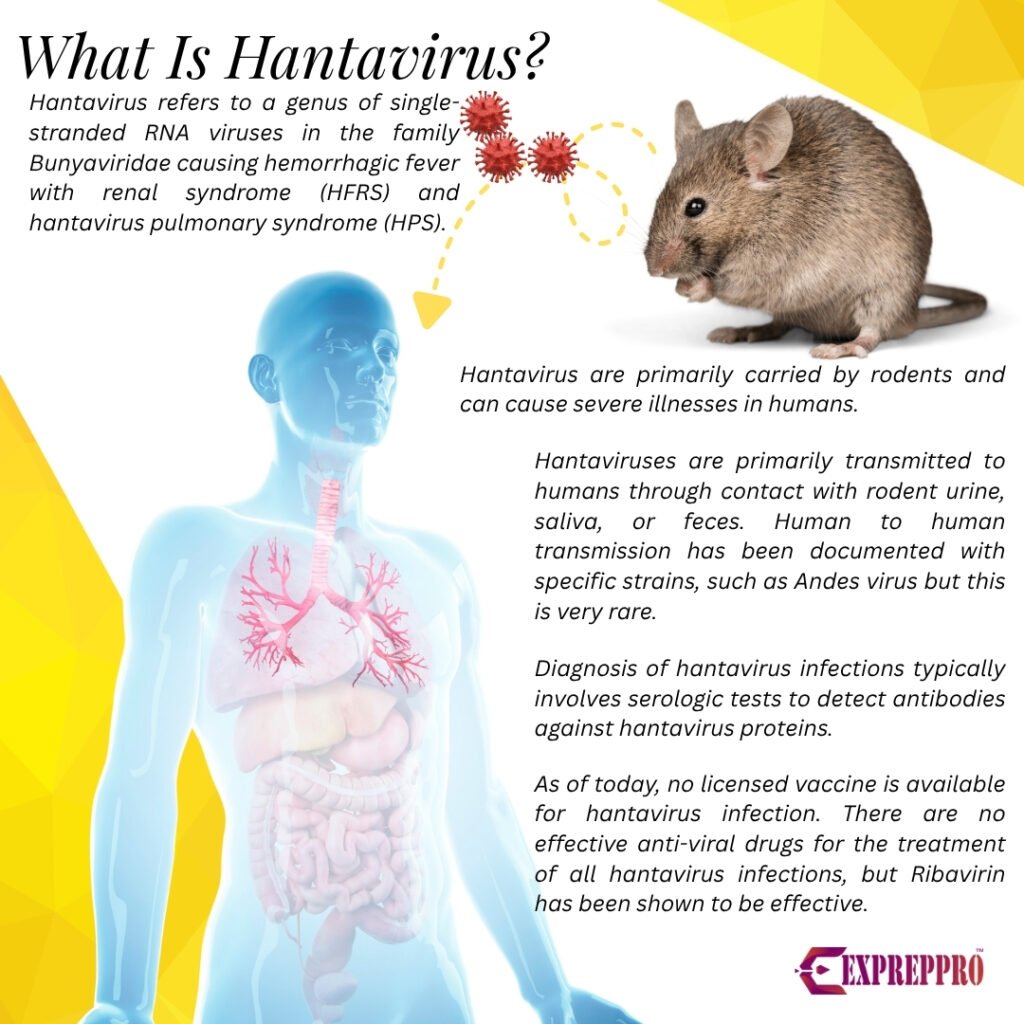
Hantavirus disease is a life-threatening disease caused by a negative-sense RNA virus in the Bunyaviridae family, spread to humans by rodents, and it has symptoms similar to influenza. The family Bunyaviridae, which has over 300 viruses and affects people, plants, animals, and arthropods, contains the genus Hantavirus. Hantavirus strains can be categorised into two: those that cause Hemorrhagic fever with renal syndrome (HFRS) and those that are the etiological agents of Hantavirus pulmonary syndrome (HPS). (Both differ primarily in terms of target organ and disease severity).
Hantavirus outbreak news.
The MV Hondius, a cruise ship, was affected by a deadly hantavirus outbreak. On 2 May 2026, the situation was reported to the World Health Organisation.
History of the Hantavirus.
If you look back at the history of HFRS, it was first recognised in ancient China. Later, the same disease entered the Russian clinical records in 1913. The outbreak was reported again in Russia in 1932, later in Sweden and Manchuria in 1934. The Hanta virus became a focus point when its outbreak occurred during the Korean War, which affected over 3,000 soldiers engaged in the Korean War. In those days, instead of HFRS, this disease was called Korean Hemorrhagic Fever or KHF, and its mortality rate was approximately 7%. In 1993, HPS was identified due to an outbreak in the four US states of Colorado, New Mexico, Arizona, and Utah; later, isolated cases were reported from Louisiana, Florida, New York, and Canada. In 1996, cases of HPS were reported around El Bolson in Argentina.
Types of Hantavirus.
The Hanta virus strains discovered in Asia and Europe differ from those in America. The virus strains found in both regions are divided into Old World hantavirus and New World hantavirus.
The old world virus primarily causes Hantavirus and is found in Asia and Europe. Hantaan virus, Seol virus, and Puumala virus belong to this category.
The New World hantavirus primarily causes HPS and are found in the American continents. Sin Nombre virus and Ades virus belong to this category.
Major Strains that cause disease.
- The Sin Nombre virus (with its Monongahela and New York variants) is responsible for most cases of HPS in the United States and Canada.
- In Europe, most of the HFRS cases are caused by the Puumala virus.
- Saaremaa virus (SAAV) carried by Apodemus agrarius has been detected in field mice in Central and Eastern Europe (Estonia, Russia, Denmark, Slovenia, and Slovakia).
- Choclo virus, Andes virus, Bermejo virus, Lechiguanas virus, Maciel virus, Oran virus, Laguna Negra virus, Araraquara virus and Juquitiba virus are involved in causing HPS in South and Central America.
As of 2017, there were 41 known species of hanta viruses, but it is still a debated question whether they should be classified as a separate species or not.
Reservoir Hosts.
A wide variety of rodent species, like:
- striped field mouse
- Brown-eared Norway rat
- bank vole
- yellow-necked field mouse
- deer mouse
- cotton rat
- rice rat
- white-footed mouse
They are major natural reservoirs for hantaviruses. (Other rodents also act as reservoirs). Some insectivore animals are also known to spread Hantavirus. Cats and dogs are not known carriers of the disease.
Transmission.
Hantaviruses are primarily transmitted to humans through contact with rodent urine, saliva, or faeces. Strains of this virus are species-specific, with a single species of murid rodent hosting a single strain of Hantavirus. Once infected, the rodent will secrete virions for an undetermined period of time. Humans usually become affected via inhalation of aerosolised virions. Human-to-human transmission is very rare and has been documented with the Andes virus.
Molecular biology of Hantavirus.
Hantaviruses are spherical in form, belong to the category of negative-stranded RNA viruses and range in size from 80 to 120 nm. Three single‐stranded negative‐sense RNA strands make up the Hantavirus genome. These three segments are designated as small, middle, and large based on their sizes.
Weaponization of Hantavirus.
Viral strains that produce HFRS are classified as Category A potential bioweapons, and genotypes that produce HPS are categorised as Category C emerging pathogens.
Hemorrhagic fever with renal syndrome and Hantavirus pulmonary syndrome.
Hemorrhagic fever with renal syndrome or HFRS is characterised by symptoms such as high fever, chills, hemorrhagic manifestations, and renal failure. The disease progresses through phases, including febrile, hypotensive, oliguric, and polyuric phases and may cause death at any stage. Hantavirus pulmonary syndrome will initially start with flu-like symptoms, such as fever and myalgia, which rapidly develop into severe respiratory distress due to pulmonary edema. Here may be the onset of the cardiopulmonary phase in which cardiac abnormalities occur, and the disease progresses rapidly.
The harm caused by hantavirus infection seems to result indirectly from the immune reaction. Thus, raised levels of CD8+ T and B lymphocytes are seen in the blood and in kidney biopsies from certain HFRS infections.
Treatment.
At present, neither HFRS nor HCPS has a particular US Food and Drug Administration‐approved therapy; instead, supportive care focuses on close clinical monitoring and management of respiratory, cardiac and kidney complications. There are no effective anti-viral drugs for the treatment of all hantavirus infections, but Ribavirin (widely-used RNA virus mutagen) has been shown to be effective against some Hantaviruses both in vitro and in vivo. Ribavirin has been used in the treatment of HFRS in China, which helped to reduce mortality (Not effective in the treatment of HPS in the cardiopulmonary stage).
Favipiravir and Lactoferrin, an iron‐binding glycoprotein, have been shown to be effective against Hantavirus both in vitro.
As of today, no licensed vaccine is available for hantavirus infection. In the United States, a recombinant vaccinia virus was developed and tested in phase I and phase II clinical trials, but it is still in the research stage. In China and Korea, vaccines made from cell culture and from rodent brains have both been created and tested on people. The most important vaccine against Hantavirus is Hanatvax.
Hanatvax.
Hanatvax is a formalin‐inactivated vaccine made by South Korea to prevent Hantavirus. This vaccine is administered in three doses at 0 days, 01 month, and 12 months. With a three‐dose regimen, Hantavax is believed to show a two‐year immunogenicity and booster effect. But even after the three doses of vaccination, a case–control study carried out in the Korean army failed to demonstrate statistically significant efficacy.